












 a rather nice ammonite found on vancouver island british columbia, at the royal britsh columbia museum in victoria (my post about this coming here in the fall... along with the wrap up to the OH-lympics!)
Showing posts with label Fossil- invertebrate. Show all posts
Showing posts with label Fossil- invertebrate. Show all posts
6.9.10
fossil of the weekend #79
a rather nice ammonite found on vancouver island british columbia, at the royal britsh columbia museum in victoria (my post about this coming here in the fall... along with the wrap up to the OH-lympics!)

28.8.10
fossil of the weekend #78
 seems the company that mines ammolite donated a big jewelfied ammonite to the royal british columbia museum too (the first museum i encountered one of these at was the royal tyrrell... maybe only royally appellated institutions get them?)
15.8.10

6.6.10
fossil of the weekend! #72
 a rather nice fossil crab, at the royal british columbia museum.
stay tuned for my (mis)adventure there coming soon!
30.5.10
fossil of the weekend! #71
as part of peter's new promotion of both the dinosaur winter games, and us dinosaurs in it, he took us across george's straight to victoria for a special appearance at the royal british columbia museum. the post on this, dare i say, misadventure is coming up soon, but thought i could start previewing the museum through its fossils here on the weekends...

you're first sneak peek of the RBCM is this rather lovely belemnite. belemnites were very similar to squid (which they were closely related too) but had much harder "guards", aka inner shells, which is what you see here. due to these harder shells belemnites fossilize quite easily (at least this particular part of them).
the belemnites evolved during the devonian period, and finally went extinct in the cretaceous. they reached the height of their success in the jurassic and cretaceous.
11.4.10
fossil of the weekend! #64
 a large ammonite on display at the royal tyrrell museum. this particular specimen exhibits the rather unique preservation known as ammolite. this is only known to occur in ammonites fossilized near the northern rocky mountains.
the photo doesn't do it credit, this shell actually refracts the whole light spectrum rather like a CD or DVD. very pretty and cool! these particular shells (coming from a common and well understood species) are mined for use in jewelry. due to its beauty and abundance in the province, ammolite is alberta's official gemstone.
18.9.09

18.7.09
fossil of the weekend! #33 and palaeo challenge #4
 a fossil snail shell, from the new layer i'd "discovered". little did i realize that these little things were THE KEY clue in the whole ongoing poaching crisis around drumheller!
this leads to the latest palaeo challenge people of the innerweb. complete with a cool prize from prehistoric insanity for any correct guesses!
it was right in front of my snout the whole time (and anyone who reads my blog!). i'd stumbled on the answer to this already in my trip. the hordes of snail and clam shells that lined this specific layer turning up throughout the horseshoe canyon formation were telling me what the poachers were after. only i hadn't thought of it!
can you figure out what a huge number or snail and clams in a mudstone layer left by a slow moving river could indicate? (hint i talked about it in a previous post during my homecoming, i just hadn't connected the two!)
10.4.09

28.3.09
field journal #6
my luck looking for francis slate's lost quarrys had not been so good thus far.

 you also can't help but see it in the rocks either when fossil/quarry hunting. this end of the vallery is jam packed with coal seams!
so much so that you get a lot of eroded coal covering the other layers in the hills. like this spot here. this can be annoying not only does it make it often harder to find stuff, but it can make the other layers rock type harder to identify...
 not that you have to ID that many layers. more than half the major coal seams in the valley run through the east end of the valley. which is why so many more coal mines used to exist down here, than in drumheller proper.
coal of course is the left over remains of a swamp, though a fossil itself, is terrible for finding anything else. the acid from all the decomposing plants in the swamp would eat away any other potential fossils long before they could be preserved.
 though in the layers between the coal we do get a few fossils. these are funny enough not from land animals or plants at all though. rather shallow marine (aka ocean) critters. such as this clam.


 watching the sun set over the valley i knew somewhere out there not only were slate's old dig sites, but so were the ruins of dozens of old coal mines.
though i'd been finding some cool stuff along the way, i also hadn't made any earth shattering discoveries along the way either.
rather than risk getting my spirits down, i decided to shake things up and switch where i was looking. i'd been centering around drumheller itself, due to its rocks having a higher occurrence of dinosaurs (check out my post on geologic layers for the full details). however i did know that francis slate had been working in other areas in this region of the valley.
so i decided to shift my hunt to pretty much the opposite end of the drumheller area, and head 30 minutes east to the small villa of east coulee...
home of the atlas coal mine historic site and museum. this is the only remaining coal mining site left in the valley, and the last remnant of drumheller's glorious past as a hub of mining.
i always get a little sad around here. there is a lot of history about the place, which isn't surprising as ALL the mines buildings and structures are intact and preserved. you can't but notice and feel the stuff that went down around here.
you also can't help but see it in the rocks either when fossil/quarry hunting. this end of the vallery is jam packed with coal seams!so much so that you get a lot of eroded coal covering the other layers in the hills. like this spot here. this can be annoying not only does it make it often harder to find stuff, but it can make the other layers rock type harder to identify...
not that you have to ID that many layers. more than half the major coal seams in the valley run through the east end of the valley. which is why so many more coal mines used to exist down here, than in drumheller proper.coal of course is the left over remains of a swamp, though a fossil itself, is terrible for finding anything else. the acid from all the decomposing plants in the swamp would eat away any other potential fossils long before they could be preserved.
so despite the abundance of coal mines here from the 1910s till the 1940s, there was quite the lack of fossil hunters during that time.
though in the layers between the coal we do get a few fossils. these are funny enough not from land animals or plants at all though. rather shallow marine (aka ocean) critters. such as this clam. the rock layers at this end of the valley are from the end of the bear paw era (74 mya to 72 mya), which was a warm time period world-wide. meaning sea levels were high, and so the middle of north america was underwater like pictured above. this part of alberta was the coastline of the interior seaway, called the bearpaw sea (hence the time periods name), during this time.
as the sea level fluctuated over time it would flood this area, and thus we get marine (again oceanic) sandstone layers with fossil shellfish (and very rarely things like fish and marine reptiles... VERY rarely mind you!). at other times the sea would retreat, and open this up to be wet swamp lands. as the ocean would invade again it would bury these swamps, and thus why we get as coal seams.
so what would francis slate be doing out here? well during his time the geology of this area was just being figured out (quite possibly by him in some places in fact), and thus he probably wasted time exploring it... much like me today. only i was hoping to merely mimic his waste of time, and find a spot where the was time wasteage had occurred (the whole while in my time i'd have made a brilliant use of my time!).
darren tanke had found his only slate site around the atlas coal mine (and the only other known slate quarry was my birthplace!). mr. slate had found part of a mosasaur, one of the only on record from this part of alberta, just up the river from the atlas 4 mine.
by the end of my day looking, darren's site was going to remain the sole lost quarry location around here.
francis slate was pretty consistent on only recording scientifically important spots. with the lack of any fossils out here other than shellfish, it made sense that none of the other slate field reports were going to be from the bear paw (again mosasaurs or any marine reptiles for that matter aren't common here by any stretch... so his one find was incredible as was).
at least i could sure now there weren't anymore out here.
at least i could sure now there weren't anymore out here.
the thing is i know from his field reports most of slate's activities in the drumheller area were around the many coal mines operating during that time. i was drawn to the atlas 4, because it was the only still standing mine in the valley. with my tiny brain it drew my attention as the sole mine i could easily pinpoint. all the others were long gone. mostly...
 watching the sun set over the valley i knew somewhere out there not only were slate's old dig sites, but so were the ruins of dozens of old coal mines.
i was going to have to track down these mines if i was going to find slate...
and for that i was going to need some help!
25.3.09
field journal #5
if i was going to find the lost quarrys of francis slate i was going to need to change my point of view in my search...
as in my actual vantage point.
one of the key things to finding a lost quarry is spotting key landmarks that are in the old photographs. if you can find and line up a landmark you can triangulate and locate a long age dig site.
so far my field work had kept me below hill level, and i was getting no closer to finding anything (or at least that's how it felt).
so i had an idea for today to see if i could change that.
 walking to the valley wall i decided to climb to the top. as this is the side of the badlands it has the highest perspective, and i hoped from up there i'd be able to see more of the valley's distinctive hills.
 that sounded easier than it actually was though. man those hills are deceptively steep!
it took me a little while to climb all the way up to the top.

it was worth it for the view. for example this nice one of the tyrrell.
at the same time it turned out to be a total waste of time due to the view...
it turns out looking down into the badlands just doesn't quite help the problem.
when viewed from above all the hills end up looking the same. when you get below them and are looking up at the hill you have the sky behind them to notice details, and from you get a better idea of scale. from up on top of the valley the hills look more like mounds in a way, and you certainly can't tell them apart from each other easily.
so not so helpful afterall...

climbing down i thought i might as well talk about the very top layer of the valley while i'm up here. as typically i don't poke around this geologic unit, and nor was i likely too again anytime soon!

here is the top layer of the red deer river valley. the one above the green line, which you might remember from my 3rd palaeo challenge.
this "unit" (as the pros call it) is known as the glacial lake drumheller layer, and is the remnant of the mechanism that created the valley and the badlands in the first place.
two million years ago, in the neogene period, the ice age began and covered a lot of canada (and then later on part of the united states too) with ice. now i'm not talking about a little bit of ice. more like 2km thick sheets of ice as far as the eye could see (or not see, as would have been the case for under your feet)!
this huge amount of ice weighed so much, and moved with such power that removed huge amounts of sediment from the prairies (it was like a surface based tectonic plate!). this removal of layers cut down rocks laid down in the cretaceous which until then had been deep underground (of rocks laid down after the dinosaurs extinction)...
about 20,000-15, 000 years ago the glaciers had retreated to the north side of where the red deer river valley is today. the valley wall i JUST climbed would have been the edge of the ice (minus the erosion that has expanded the valley about a km since it was formed, but it is close enough for me to think that is cool)...
at this point in time, due to re increasing global temperatures, the glaciers were melting (slowly mind you). as of such they were producing a lot of melt water. some of this was trapped behind the glaciers ice, causing giant ice locked lakes...
(Production Note: Video from John Accorn's Adventures in Discovery)
eventual the wall of ice holding in this water melted, and let loose a WHOLE lake worth of water at once. naturally this caused a flood event, and that water needed somewhere to go! watch the video at this point to see what i'm talking about.
as there were no set drainage systems in place the water carved itself a new one... what you and me call a valley.
this cut into the prairies, cutting straight into the fossil rich layers of the cretaceous, which are present throughout most of alberta, but are underneath other layers (which again in the prairies the ice scooped off). meaning alberta has a unbelievably huge supply of fossils in it, most of it is buried deep beneath the surface... much like most places in the world, only we get lucky and have a few exposures of these layers in these glacial run off valleys.
 which as a story is cool. which if your a geologist is cool. which if your a dinosaur fossil hunter is uncool...
the reason being is that this top layer of fine yellow mudstone is about 64 980 000 years to recent to contain any dinosaur bone... or any other mesozoic era fossils. meaning if your looking for those sorts of fossils like me, this layer is useless!
not to mention unfun to get to... being so high up the hills!
as in my actual vantage point.
one of the key things to finding a lost quarry is spotting key landmarks that are in the old photographs. if you can find and line up a landmark you can triangulate and locate a long age dig site.
so far my field work had kept me below hill level, and i was getting no closer to finding anything (or at least that's how it felt).
so i had an idea for today to see if i could change that.
walking to the valley wall i decided to climb to the top. as this is the side of the badlands it has the highest perspective, and i hoped from up there i'd be able to see more of the valley's distinctive hills.that sounded easier than it actually was though. man those hills are deceptively steep!it took me a little while to climb all the way up to the top.
it was worth it for the view. for example this nice one of the tyrrell.
at the same time it turned out to be a total waste of time due to the view...
it turns out looking down into the badlands just doesn't quite help the problem.
when viewed from above all the hills end up looking the same. when you get below them and are looking up at the hill you have the sky behind them to notice details, and from you get a better idea of scale. from up on top of the valley the hills look more like mounds in a way, and you certainly can't tell them apart from each other easily.
so not so helpful afterall...
climbing down i thought i might as well talk about the very top layer of the valley while i'm up here. as typically i don't poke around this geologic unit, and nor was i likely too again anytime soon!
here is the top layer of the red deer river valley. the one above the green line, which you might remember from my 3rd palaeo challenge.
this "unit" (as the pros call it) is known as the glacial lake drumheller layer, and is the remnant of the mechanism that created the valley and the badlands in the first place.
two million years ago, in the neogene period, the ice age began and covered a lot of canada (and then later on part of the united states too) with ice. now i'm not talking about a little bit of ice. more like 2km thick sheets of ice as far as the eye could see (or not see, as would have been the case for under your feet)!
this huge amount of ice weighed so much, and moved with such power that removed huge amounts of sediment from the prairies (it was like a surface based tectonic plate!). this removal of layers cut down rocks laid down in the cretaceous which until then had been deep underground (of rocks laid down after the dinosaurs extinction)...
about 20,000-15, 000 years ago the glaciers had retreated to the north side of where the red deer river valley is today. the valley wall i JUST climbed would have been the edge of the ice (minus the erosion that has expanded the valley about a km since it was formed, but it is close enough for me to think that is cool)...
at this point in time, due to re increasing global temperatures, the glaciers were melting (slowly mind you). as of such they were producing a lot of melt water. some of this was trapped behind the glaciers ice, causing giant ice locked lakes...
(Production Note: Video from John Accorn's Adventures in Discovery)
eventual the wall of ice holding in this water melted, and let loose a WHOLE lake worth of water at once. naturally this caused a flood event, and that water needed somewhere to go! watch the video at this point to see what i'm talking about.
as there were no set drainage systems in place the water carved itself a new one... what you and me call a valley.
this cut into the prairies, cutting straight into the fossil rich layers of the cretaceous, which are present throughout most of alberta, but are underneath other layers (which again in the prairies the ice scooped off). meaning alberta has a unbelievably huge supply of fossils in it, most of it is buried deep beneath the surface... much like most places in the world, only we get lucky and have a few exposures of these layers in these glacial run off valleys.
which as a story is cool. which if your a geologist is cool. which if your a dinosaur fossil hunter is uncool...the reason being is that this top layer of fine yellow mudstone is about 64 980 000 years to recent to contain any dinosaur bone... or any other mesozoic era fossils. meaning if your looking for those sorts of fossils like me, this layer is useless!
not to mention unfun to get to... being so high up the hills!
 the glacial lake drumheller layer is not completely devoid of fossils mind you. all throughout this very recent unit are the shells of little fresh water snails that lived in the freezing cold lake (about the only thing tough enough to survive in the 4 degree water!). which are neat, but just don't enthrall me after a few, and certainly not worth the huge climb up the hill to find them.
besides i see enough of them while looking for fossils. some of them end up washing down the hill to the bottom of the valley, and you can find them along side equally eroded and washed out dinosaur bones...
anyways back to the prospecting trail i guess (as i can't use a drawing board in this case)...
29.11.08
the royal tyrrell museum
now that i'm back in canada, and specifically drumheller it only made sense that i would return to my former home AND workplace. the royal tyrrell museum.
_
now of course i've talked a lot about this museum here on my blog, but as i didn't really start this blog till after i'd left the museum i haven't posted much about it (and when i did in those early blogging times i didn't cover it well). so i'm going to fix this lack of tyrrell info on my blog with this the definitive traumador guide to the museum!
 so in the words of the museum's spokesman john acron (i've met him before!) "welcome to the royal tyrrell museum" though of course "this is not the museum it is merely the sign!"
now of course you want to know more about the museum as opposed to the sign so...
the museum to start off with, is located within midland provincal park, and thus technically makes it just "outside" of drumheller. it is halfway along the north dinosaur trail (the trail being two roads that run east/west one on each side of the red deer river valley on which most of the valley's tourist attractions are located). it is either a 5 minute car drive or an hour walk from downtown drumheller.
 the royal tyrrell museum of palaeontology is the only major museum in all of canada dedicated to just the science of palaeontology. the museum's slogan "celebrating life" summarizes this topic perfectly, if you ask me.
the museum opened in 1985 as just the plain old tyrrell museum of palaeontology. however 10 years later in 1995 due to the museum's important work and increasing reputation the queen of england gave it her approval, and it gained the royal on the front of its name.
being run and operated by the government of alberta the tyrrell runs on a philosophy of preserving, protecting, and presenting the fossils of the province for albertans now and forever to enjoy. due to museum's specialization in palaeontology it is headquarters for a lot of the fossil management in the province. if you want to dig in alberta you'll need to apply to the museum for the permit (though if you don't have a PHD you most likely won't get it... trust me i've tried!).
 to help it with its mission of preserving, protecting, and presenting the museum has a whole army of palaeontologists in its employ. just like my buddy dr. françois therrien here.
each one has a different interest and speciality so that the museum can study and present as much of the science as possible without too much overlap. these palaeontologists function as curators, whose job is to direct and supervise the collection, research, and presentation of fossils in their field of study. its an important job (and one i some day hope to get!).
when i left the museum it had 6 curators, but in response to some really sad deaths and just ordinary staff changes the museum now has 7. a few of whom i've never met...
 well in order to preserve, protect, and present anything the tyrrell of course must collect fossils. with its crew of very talented and dedicated technicians, like fossil hunter extraordinaire and all round nice guy darren tanke above, the museum is very good at collecting them.
the tyrrell actively excavates (that's the biz term for digging/collecting) fossils from dozens and dozens of sites all over alberta that yield everything from dinosaurs, to marine reptiles, ice age mammals, fossil pollen, placoderm fish, and various invertebrates. however they have collected many times outside the province as close as BC and as far away as china and even antarctica!
 so how do you preserve and protect fossils. well the number one favour you can do the fossils, so they stick around, is to get them out of the damaging elements. pretty much everything nature does from raining, snowing, being sunny, or windy damages fossils. if they are left outside in the elements these remains of the deep past would erode into nothing more than dust. instead the museum brings them back to the museum (or sometimes one of a couple warehouses it has) and stores them in the unprepared collections.
as john acron funnily puts it "and why are they unprepared you might ask? i mean hey, these fossils have been around for millions of years you think if they were going to be prepared for something, they would be by now!". of course unprepared means that the fossils have only been worked on by people enough to safely get them out of the ground. they typical need more work to be fully seen and studied. the process by which we clean them off is called preparation.
like all good museums the tyrrell has a huge back log of unprepared specimens. the majority these were collected in the 80's, 90's, and 2000's, but a fun game to play in the unprepared collections, as they're all labelled, is finding the oldest jacket! . the oldest i could find was from 1937, and there many others of dates between this and 1985.
 in order to get these fossils prepared the tyrrell has state of the art fossil preparation labs and facilities. here the techicans, like my friends david and dawna here, patiently and carefully work on cleaning off and repairing these fossils so they can be looked at and studied.
 when it comes to the protection directive, this is the place to go. the prepared collections area. once a fossil is cleaned off (prepared) it comes here to be stored. this is more than just a big warehouse where things are dumped though (unprepared collections is more like that). this is more like a big library of fossils...
every specimen is given a number, and is stored in an appropriate section of the collection. all the fossils are catalogued in huge books that include information like where the specimen was found, who found it, who prepared it, and even which scientific literature it is mentioned in.
over 200 000 fossils are catalogued in the collection, of which over 93 000 are dinosaurs. this makes it the largest fossil collection in canada, and one of the larger collections throughout the world. nearly a hundred scientists visit the museum every year to look and and study the fossils in these collections (and it can be way more when the museum is hosting a big gathering of scientists like a conference or synposium!).
 the tyrrell however is much more famous for the last of its three directives, and that is the presenting. the museum boasts world class fossil exhibits open to the public all year round. so world class that many other museums have visited it to get ideas for their own displays. i'll be taking you on a virtual tour of these shortly...
over 300 000 visitors check out the museum each year, and about 200 000 of these come during the summer season. i remember this crazy stretch of 3 months well! rounding off the presentation side of things the museum has cutting edge education and interpretation programs and services. these range from knowledgeable staff (and some dinosaurs ;p ) on the museum floor to answer guests' immediate questions, to tours and hikes, school programs, and even a full on summer camp!
i used to work in this portion of the museum for the most part when i worked here. being everything from a dinosaur on the gallery floor to a expert guest at the badlands science camp i got around presenting (even with my brain if i got it wrong a lot!).
so that in a nutshell is the museums overall structure and battleplan. now to take you on a quick virtual tour of the museum. some of this stuff is new, and i hadn't seen it till this recent trip. so it just goes to show much like the prehistoric life it it presents within the museum is evolving itself.
Cretaceous Alberta
 the entrance to the museum galleries is brand new. back in my day it was a giant globe floating in space. now it is a much more impressive recreation of alberta 70 million years ago. here you will encounter a pack of albertosaurs wandering through a dried up riverbed.
i'd run into the albertosaurs before when i briefly tried to get my job back in the xmas of 06. whats really cool about this new display, beyond the fact its cool pretending to walk back in time, is that it is self interpreting. meaning there's no signs to tell you what you're looking at or more to the point where and what to look at in the first place. it is just as if you travelled back in time and can explore it on your own.
so for example you have to both notice the scars on the snout of this running albertosaur, and figure out possible causes for them on your own.
 right down to minor but amazing details like all these replica fish, turtles, and invertabrates in a small pond.
there's all sorts of other things to spot and think about, but i'll leave that till a later post or for you to see yourself when you visit the museum.
Great Minds Fresh Finds

next up is this display, which not only showcases the curators of the museum, but also their current work. its a really nice setup, and if you're not familiar with the scientists of the museum its a great way to get to know what their up to.
 its also the area where any tyrrell fossils recently in the news are put on display. such as this eggnant adocus turtle (that's my new word for pregnant with eggs... i hope it catches on!) which you may have heard about a couple months ago or read about on the blogs.
needless to say the whole great minds fresh finds area has changed a lot since the last time i was here. what with new research in the past 2 years, and some new curators starting on since than.
Lords of the Land
 another sort of new, but yet not really, area is the lords of the land. it used to be called the theropod hall and showcased meat eating dinosaurs from around the world. now they've replaced all the foreign theropods with alberta ones, and redecorated and re lite the exhibit so it looks like an art gallery.

it looks really nice and artsy, but at the same time is an extreme case of what i call "museum lighting". it looks real nice when you're there, but you can't really take pictures. worse the lighting directs and dictates what and how you see the specimen. it takes the exploration out of the museum visit and it tells you what to see, and i think that kinda takes the fun out of it.
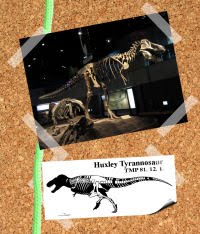
the show case piece of this hall is still the mounted tyrannosaurus rex in the centre of the display. it is one of two tyrannosaurs the tyrrell boasts... of course the other t-rex is a little more signficant to me. that being my mother the huxley tyrannosaur.
next you hit the "main" galleries of the tyrrell which are fossil halls setup as though you were travelling from the beginning of life towards the present. so the first place you'd end up on such a time journey would be...
The Burgess Shale
 one of the tyrrell's coolest displays has to be its burgess shale recreation. here you travel through a magnified scene of the cambrian as though it were in a fish tank (the animals are 12 times their original size as otherwise you won't see most of them well). it even has a glass floor that allows you to look at the ocean floor your walking above.
the only problem with it is that it doesn't photograph well as you can see. so be sure to visit just for this exhibit. there isn't another burgess shale display this cool i've ever heard of! there is also a nice interpretive section on the burgess shale, and the tyrrell's efforts in the 1990's to find other sites around field with the same critters.
 it also has a huge selection and display of burgess critters. which was cool to have when i was first reading wonderful life. i could just run up stairs from where i was reading and look at the stuff. not that i want to rub it in. it just made the book that much cooler!
Devonian Reef

next we jump to the devonian and one of the reefs that ties into alberta's rich oil deposits. here you get an awesome fish tank style recreation of the time period. i think this is where my love of aquarium began, growing up and watching this reef. which tells you how cool it is. nothing in it is alive or moving, yet it could captivate me for hours, and i have a real short attention span most of the time people of the innerweb!
Onto the Land

the first display you hit coming down stairs is the highlights of life's conquest of the land. its a cool display that shows you the progress from the first tiny plants to make it onto land all the way to amphibans emerging into a fully developed terristial ecosystem.
Permian Hall
 next we come to the biggest extinction in the earth's history. despite alberta not really having much fossil material from this time, using casts from elsewhere in the world the tyrrell shows off this time period well.
 among my favourite is the wall of skulls of the bizarre and diverse reptiles and sort of reptiles that are from this era. if you think dinosaurs had the monopoly on weird, one look at this wall should hopefully fix your opinion. mind you in this pic dimetrodon isn't one of the weirdos. all around him are some though. my photos of them didn't turn out so well sadly :(
 speaking of dimetrodon what permian display won't be complete without everyone's favourite not a dinosaur. emphasis on the display is made that this is not a dinosaur, but rather the apex predator of another time, and an ancestor to you mammals!
Cretaceous Garden
immediately after the permian display, is a tucked away entrance to the most often missed part of the tyrrell, the cretaceous garden. seriously now that you've been warned watch for it! the gallery staff get the question of where the garden is seriously hundreds of times a day.
this is a special living collection of plants whose decsendents were alive in alberta during the cretaceous.
it is a special place to me as for 2 years of my life this was my home! i lived here for most of my time in drumheller, and all of my time after getting my job at the tyrrell (immediately after being hired i was kinda kicked out of dan and craig's apartment and this is where the museum put me up).
Triassic Giant
 my favourite of the new things added since my departure was the triassic giant. ever since the death of marine reptiles curator betsy nicholls in 2004, her greatest work has sat in the museum collections unseen by the public. finally in this tribute display, her magnificant shonisaurus sikanniensis the largest marine reptile known, is out for all to see!
 i'll be blogging about this huge ichthyosaur later...
Dinosaur Hall
 of course the main attraction of the museum for most is the dinosaur hall. one of the largest in the world with over 30 dinosaur skeletons on display in one hall, and most of which are mounted in life like positions.
 my only complaint is that the hall is ALMOST presented in chronologic order. except there are NO triassic dinosaurs present, and that it goes from the late jurassic straight to the late cretaceous. i know this is mostly due to the museum in its beginning setting up a trade for some jurassic dinosaur casts in exchange for an albertosaur and some duckbills with an american museum. besides these jurassic dinosaurs all the major skeletons are those of albertan dinosaurs.
 this is in some way a minor complaint from a real dinosaur stickler... can you blame me. i am one afterall!
no the dinosaur hall is pretty fantastic. it has a representative of every major clade of dinosaur except prosauropod and hypsilophodontid (though the theropods are pretty coelurosaur centric... partial due to alberta's theropods all being coelurosaurs, and also the pack of the primordial feather pushing for this)
 it definately is worth the visit for any of you dinosaur buffs out there on the innerweb!
Ceratopsians
 one of the new displays that i'm not entirely keen on (just because it resulted in the firing of the girl of my dreams lillian the albertosaur) is the new ceratopsian exhibit. again i did say not entirely. for the most part i think it is rather cool. other than the drab colours they used. it makes them seem boring...
which dinner shouldn't be if you ask me. man i could go for a ceratopsian burger right about now.
 here you'll find many of the new horned dinosaurs that have been in the news lately. such as eotriceratops pictured here. there are several other, but i'll blog about these in a bit.
 also there is the new ubber cool yet to be formally described or named "dinosaur park pachyrhinosaur".
Bearpaw Sea
 next we come to a childhood favourite of mine. the marine reptiles of the ancient interior seaway. here you get to see some of the amazing animals that lived along side the dinosaurs.
when i was a hatchling craig would bring me in here to lull me to sleep. so i have very fond memories of here.
KT Extinction
 the last bit of the dinosaur hall covers the very upseting demise of my kind. in fact for me this section is just an emotional rollercoaster because not only is it the sad story of the end of the dinosaurs, but my mother is on display here. i haven't been able to talk to her in 2 years...
Mammal Hall
 from here you hit the often skipped or quickly run through age of mammals. after all the amazing displays before it, visitors and staff often wear out and just breeze through here.
not that i blame them. i find mammals kinda boring myself. though to be fair if you take the time to explore these displays their actually pretty good.
Ice Age

the one exception to the skipped mammals is the ice age exhibit, with a mammoth under attack by saber toothed cats. people love this one, and it is one of the most photographed parts of the museum!
sadly after this you've caught up to the present era, and thus the end of the museum and you end up in the gift shop.
so i hope you've enjoyed your virtual tour of the royal tyrrell museum. again i couldn't possible do it any justice here on the web wide world, and you really should visit it anyway.
do stay tuned to my blog for the next little while as i'll be doing more posts as i visit around here.
to see some of my older posts on the museum click here.
Subscribe to:
Posts (Atom)